
30 Jul AI Slop Is Flooding the Internet. Here Is What the Co-Founder of Substack Predicts Happens Next.
40 percent of long-form content on LinkedIn is now fully AI-generated.
That estimate comes from Pangram, one of the leading AI text detection companies. And when Chris Best, the co-founder and CEO of Substack, heard it, it changed how he thinks about the internet.
Not because AI is bad. Best is not anti-AI. He uses it himself. But because of what happens to a platform, a community, or a business when the ratio of human to machine-generated content tips far enough in one direction.
His prediction is not reassuring. And it has direct implications for every business owner who is thinking about how to use AI in their marketing.
Quick Answer: What Is AI Slop?
AI slop is content that nobody actually believes in. It is not defined by whether AI was used to create it. It is defined by whether a real person engaged with the material, took a genuine position, and is prepared to stand behind it. According to Chris Best, slop exists on a spectrum from outright spam to what he calls ‘recognizably Claude copy-paste,’ and its real damage is not the individual piece of content but what happens to the reader when enough of it accumulates.
The Definition That Actually Matters
Most conversations about AI-generated content focus on the wrong question. People argue about whether AI was used, how much, and in what way. Chris Best argues that this misses the point entirely.
His definition of slop is not about the tool. It is about intent and presence. Content becomes slop the moment the person who published it skips the step where they have to actually believe in anything.
His clearest example: tell an AI to write a thousand viral posts, make no mistakes, and publish whatever comes back without reading it. The problem with that is not just that the content might be bad. The problem is what it does to the reader. Every person who encounters that content now has to ask themselves: is this real? Is there a person behind this? And if I respond, will anyone be there to answer?
Best calls this a denial-of-service attack against the public square. The content does not just waste the reader’s time. It degrades their ability to find anything worth trusting, including the content that is genuinely good.
The Prediction: It Gets Worse Before It Gets Better
Best’s prediction starts with a simple observation. What happened to LinkedIn is not a LinkedIn problem. It is a platform problem. And without active intervention, any platform that hosts writing will face the same trajectory.
He told the story of Substack writers who stopped reading new writers entirely because it happened too many times: they would get deep into a piece or a comment thread, start to feel something, and then slowly realize there was no person there at all. Someone had automated the engagement.
His prediction is that this erosion of trust will accelerate across every content platform as AI generation becomes cheaper and more accessible. The businesses and creators who do nothing to differentiate themselves from machine output will become indistinguishable from it in the eyes of their audience. And once an audience loses trust, it is very hard to get back.
The LinkedIn Number Should Alarm Every Business Owner
Take a moment with what that actually means in practice.
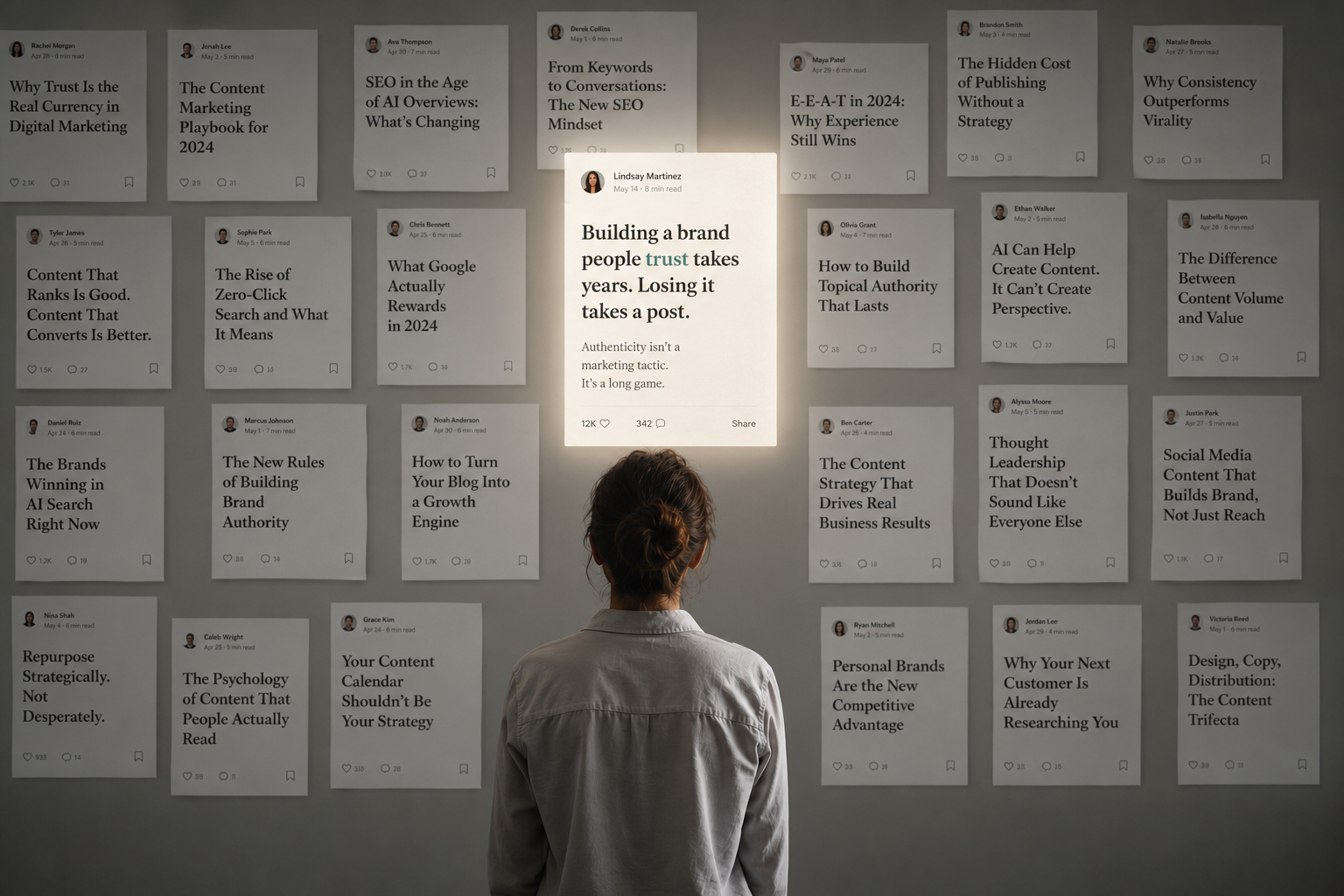
That means when a potential client scrolls their LinkedIn feed and sees your post next to a dozen others, nearly half of what they are reading was produced without a single human thought behind it. Their guard is up. Their skepticism is calibrated. And they are applying that skepticism to everything, including the content that is genuinely yours.
This is the hidden cost of AI slop that Best identifies most clearly. It is not the bad content that gets published. It is what that bad content does to the reader’s relationship with everything around it. When people cannot tell the difference, they stop trusting anything. That environment is hostile to every business trying to build a real relationship with a real audience.
His Take on Detection: Pangram Is a Starting Point, Not a Solution
Substack integrated Pangram’s detection tool into its platform so readers can scan long-form content and see an estimate of how much was AI-generated versus human-written. Best is clear that he sees this as a transparency measure, not a policing mechanism.
His reasoning is important: Pangram detects whether text passed through a language model. It cannot detect whether anyone thought hard about what they were publishing. A person can type every word themselves and produce content that is entirely thoughtless. Another person can use AI throughout their process and produce something deeply considered and entirely their own.
The tool gives readers a data point. It does not answer the question that actually matters.
Best’s honest assessment is that Pangram is a starting point and that the harder problem, detecting whether genuine human thinking went into a piece, requires something that does not yet exist.
The Idea He Thinks Would Actually Solve It
This is the part of Best’s thinking that is worth sitting with. He envisions what he calls a Pangram for ideas rather than words. Instead of measuring whether a language model generated the text, it would measure whether the ideas themselves came from the averaged center of what AI tends to produce by default, or from somewhere more original.
His observation is that AI has an intellectual gravitational pull. Ask it to write about almost any formal topic and it will include certain ideas whether you asked for them or not. Write about AI and it will find its way to ethics and governance. Write about business strategy and it will reach for frameworks and pillars. There is a recognizable conceptual center that AI orbits.
Human thinking, at its best, escapes that center. It makes connections that are unusual, takes angles that are counterintuitive, leaves out things that seem expected, and includes things that seem surprising. Best believes a tool that could measure ideational distance from the AI average would be far more useful than one that measures whether a language model touched the prose.
He does not have this tool yet. But it is the direction he thinks the conversation needs to go.
What This Means for Businesses Using AI in Their Marketing
Chris Best is not arguing that businesses should avoid AI. He is arguing that there is a bright line between using AI to make something you believe in and using AI to skip the step where you have to believe in anything at all.
That line matters enormously for how your content performs.
The Content That Will Win Is the Content That Could Only Come From You
Best’s framework points toward something that aligns exactly with what Google confirmed in its official AI search guidance: the content that earns AI recommendations and human trust is content that reflects genuine expertise, a real point of view, and a perspective that is specifically yours.
We covered what Google’s official guidance actually says in detail in our post Google Finally Published Its AI Search Playbook. The short version is that Google’s AI rewards the same things Best is describing: first-hand expertise, a unique point of view, and clear human structure. Template content and generic AI output are exactly what gets filtered out.
Quantity Is Not Strategy
The approach Best describes as slop, publishing at volume without reading what you publish, is also the approach most likely to undermine your SEO, your AI search visibility, and your audience trust simultaneously.
A business that publishes one genuinely useful, expert piece per month will outperform a business that publishes AI-generated content daily. Not just on trust signals but on the metrics that matter: leads, calls, and conversions.
Your Audience Is Already Calibrated to Detect It
Best’s observation about readers applies to your potential clients too. The business owners, attorneys, practice managers, and service professionals in your audience spend time online. They encounter AI slop regularly. Their ability to sense it is sharper than it was a year ago.
When your content feels like it came from a real person who genuinely knows your industry, that contrast becomes a competitive advantage. When it feels like it could have come from anywhere, it gets treated like everything else they scroll past.
The Video Prediction: This Conversation Will Repeat Itself
Best made one additional prediction that is worth noting for businesses investing in video content. The same trajectory he describes for written content is coming for video.
AI-generated video is already convincing enough to fool a significant portion of audiences, particularly for short-form content and for older demographics who are less attuned to the tells. Best predicts that within the next year or two, the same questions being asked about written content will be asked about video: was there a real person here? Is this authentic? Can I trust this?
His framing is useful: every medium will need new norms. We never needed a norm that said do not use AI to text your spouse, because it was never possible. Now it is possible and the norm does not yet exist. The same will happen for video. The businesses that build authentic relationships with their audiences now, before those questions become unavoidable, will be in a much stronger position when they do.
The Businesses That Will Win Are the Ones That Show Up
The through line in everything Best says is presence. Not the number of pieces published. Not the technical origin of the words. Presence. Did a real person engage with this material, take a position, and remain available to be answered?
For a business, that means content written from actual experience with your clients and your industry. It means taking positions that reflect a genuine point of view, not safe generalities. It means being willing to say something specific enough that someone could disagree with it.
That is what builds the kind of trust that generates leads. It is also, according to Best’s analysis, exactly what the internet is running out of.
FREQUENTLY ASKED QUESTIONS
What is AI slop and how do I know if my content qualifies?
AI slop is content published without genuine human engagement with the material. It is not defined by whether AI was used but by whether the person publishing it actually thought about what they were saying. If you could not describe the main argument of your last piece of published content without looking at it again, that is a reasonable signal worth paying attention to.
Does using AI to write content hurt my SEO?
Not automatically. Google’s guidance is clear that AI-generated content is not penalized by default. What is penalized is low-quality content that does not demonstrate expertise, authority, or genuine usefulness. AI content that reflects real expertise and a specific point of view can rank well. AI content that is generic, templated, or says nothing original will not.
How do I make sure my AI-assisted content does not feel like slop?
Start with a genuine position before you involve AI. Know what you want to say, why you believe it, and who it is for. Use AI to improve the clarity and structure of that thought, not to generate the thought itself. If you would not be comfortable standing behind every claim in the piece and answering questions about it, revise before publishing.
Is the AI slop problem going to get better or worse?
According to Chris Best’s analysis, it will get worse before it gets better. AI generation is becoming cheaper and more accessible, which means the volume of machine-generated content will continue to increase. The businesses that differentiate themselves through genuine expertise and authentic voice will have a growing advantage over those that do not, because the contrast will become more visible over time.
What is Pangram and should I care about it as a business?
Pangram is an AI text detection tool that estimates whether a piece of content was generated by a language model. Substack has integrated it so readers can scan content. As a business, the question is less about your Pangram score and more about whether your content would hold up to the scrutiny it represents. If your content reflects genuine expertise and original thinking, the score is irrelevant. If it does not, the score is the least of your problems.
KEY TAKEAWAYS
- AI slop is defined by the absence of human intent, not by the presence of AI tools. The dividing line is whether the person publishing the content actually engaged with the material and is prepared to stand behind it.
- 40 percent of long-form LinkedIn content is now fully AI-generated according to Pangram estimates. This level of machine-generated content degrades audience trust across an entire platform, including the content that is genuinely human.
- Chris Best predicts the same trajectory is coming for video. Businesses that build authentic audience relationships now will be better positioned when the trust questions about video become unavoidable.
- The content that wins in this environment is the content that could only come from your business: specific expertise, a genuine point of view, and a willingness to take a position.
- Detection tools like Pangram measure whether AI touched the text. The harder and more important question, whether genuine human thinking went into the piece, is something only the publisher can answer.
At Life in Motion, every piece of content we create for our clients is built around their real expertise and their specific point of view. We use AI as a tool for clarity and structure, not as a substitute for the thinking. In a world where AI slop is the default, that distinction is the difference between content that builds an audience and content that disappears.
Want to talk about what a content strategy built on genuine expertise looks like for your business? Schedule a free consult today.