
13 Jun Google Finally Published Its AI Search Playbook. We Already Told You What It Says.
Last year, we published an article on how to get your business recommended by ChatGPT and other AI tools. In it, we made a call that went against what a lot of marketing companies were selling at the time:
“You may hear about new technical files like an llms.txt. For now, that is just an idea floating around the internet, not something these systems use.”
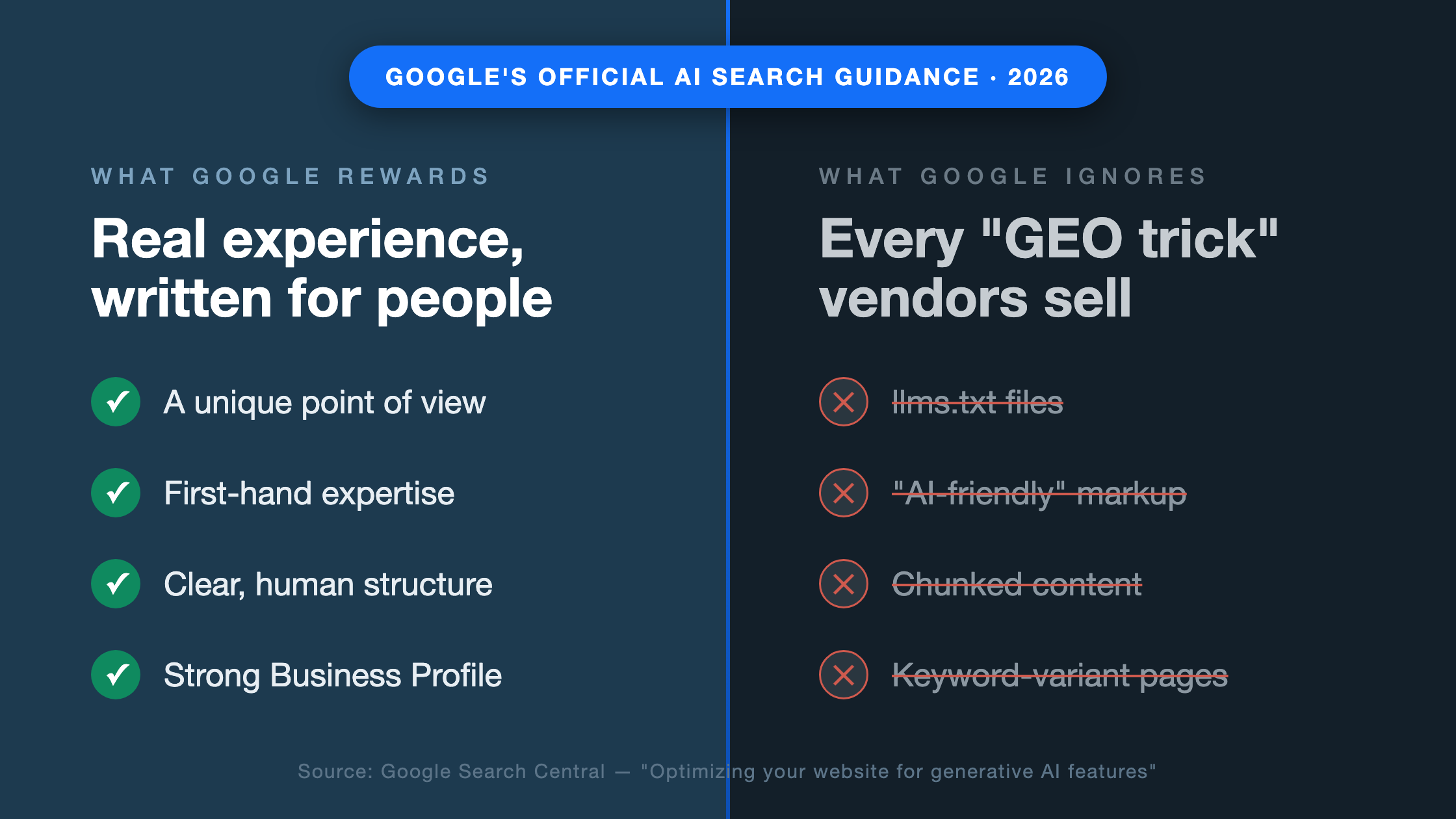
This month, Google made it official. In its new guidance, “Optimizing your website for generative AI features on Google Search,” Google states directly that llms.txt files, special AI markup, and “AI-friendly” rewriting do nothing. No special treatment. No ranking benefit. Nothing.
So what does work? Google’s answer is the one we have built our whole approach around: content that could only have come from you. Real experience, a real point of view, written for a human reader. Here is what the guidance actually says, what we did about it the week it came out, and what it means for your business.
What Google’s New Guidance Says
Google’s AI features, including AI Overviews and AI Mode, do not have their own separate index or their own separate rules. They retrieve pages through Google’s normal Search ranking systems, then build answers from those pages with links back to the sources. Google’s own words: optimizing for AI search is SEO. There is no second playbook.
That means the prerequisite for showing up in an AI answer is the same as it has always been: your page has to be able to rank in regular Search. From there, Google lists what actually moves the needle:
- A unique point of view. AI systems compare many sources at once. A firsthand perspective stands out. A summary of what is already online does not. Google’s own example of the difference: “7 Tips for First-Time Homebuyers” versus “Why We Waived the Inspection and Saved Money: A Look Inside the Sewer Line.”
- Content written for people. Clear headings, readable sections, plain language. That is the entire structural requirement.
- Good images and video. AI features surface them, which creates visibility beyond blue links.
- Technical basics. The page must be indexed and snippet-eligible. Crawlability, page experience, clean HTML. Nothing exotic.
- Your Google Business Profile. For local service businesses, GBP data feeds AI responses directly. Profile hygiene is now part of AI visibility, not a separate chore.
What Google Says to Ignore
This is the part the industry needed in writing. Google published a mythbusting list of tactics that do not work:
- llms.txt files and special AI markup. Ignored entirely.
- “Chunking” content into fragments for AI. Not needed. The systems understand normal pages.
- Rewriting content in an “AI-friendly” style or stuffing keyword variations. Not needed. The systems understand synonyms and intent.
- Paying for brand mentions across blogs and forums. Google’s spam systems counteract this.
- Special schema “for AI.” No such thing exists. Structured data still matters for normal rich results, and that is the only reason to use it.
Two of those deserve a stronger warning than “it doesn’t work.” Publishing batches of near-identical pages to chase keyword variations falls under Google’s scaled content abuse spam policy, and seeded brand mentions are addressed by its spam systems. Those are not neutral wasted spend. They are tactics that can put your site on the wrong side of Google’s published policies. If a vendor is selling them to you as “GEO optimization,” that is not a strategy. It is a liability you are paying for.
What We Did the Week the Guidance Dropped
We do not just read guidance. We audit against it.
Within days of Google’s release, we connected to every one of our client’s websites we manage and checked each one, file by file, for llms.txt and similar AI-bait artifacts. Every file found was removed the same week, and every sites we manage are now verified clean against Google’s published guidance.
That is what a real agency relationship looks like. When the official answer came out, we acted on it within days. No client had to ask, and no client got a bill for it.
We also updated our own audit methodology. Our website audits now flag two things they did not flag before: leftover “AI optimization” artifacts a previous vendor may have installed, and what Google calls commodity content, meaning pages a generic AI could have written without any access to your business.
The Real Headline: Google Is Drowning in AI Content, and It Knows It
If you want proof of how fast this shift is moving, look past Google for a moment. On June 3, Cloudflare CEO Matthew Prince reported that bot traffic has now passed human traffic online for the first time in the history of the internet, driven by the explosive growth of AI agents. Even he admits it happened faster than he predicted.
Welp, that happened faster than I predicted. Thought it would be end of 2027, then early 2027, but agentic traffic growing so fast that bots have now passed human traffic online for the first time in the Internet's history. https://t.co/2zX5bHdhsa
— Matthew Prince 🌥 (@eastdakota) June 3, 2026
Half the traffic reading the internet is no longer human, and an enormous share of what gets published is no longer human either. Anyone can generate ten thousand words of plausible content in an afternoon. Google knows this better than anyone, because it is the one indexing all of it.
So the guidance draws a line. Content that “could originate from anyone,” or that a generative model could produce without you, adds little and gets treated accordingly. Notably, Google does not ban AI-assisted writing. It judges output quality, not the tool. The dividing line is whether the content contains anything that required you to exist.
For our clients, that is genuinely good news, because it is the one game big content farms cannot win:
- The estate planning attorney who can describe how a poorly drafted power of attorney actually unraveled in probate has something no AI model can generate.
- The pediatric practice that can explain what parents in its own waiting room ask every flu season has something no competitor can copy.
- The trades company that can show photos and numbers from a real job has something a content farm cannot fake.
Your experience is now the ranking asset. The writing is just the delivery vehicle. This is why our content process starts with extracting what you know, not with a keyword list.
What This Means for Your Business
Three takeaways worth acting on this quarter:
- If anyone has sold you “AI optimization” as a technical add-on, get it audited. llms.txt files, AI schema, chunked content. Best case, they are dead weight. In the case of variant-page tactics and seeded mentions, they carry real spam policy exposure, and they signal that the vendor’s playbook contradicts Google’s published guidance.
- Inventory your content honestly. For each key page, ask one question: could a generic AI have written this without us? If the answer is yes, that page is a candidate for the commodity pile, and rewriting it around your real cases and real expertise is the highest-leverage SEO work available to you right now.
- Stop waiting for a GEO playbook. There is not going to be one. Google said so. The businesses that win AI search are the ones whose normal search presence is strong and whose content carries their actual expertise.
We wrote a full guide on getting your business recommended by Google’s AI search, and our audits now measure every site against this guidance. If you want to know where your site stands, ask us for the audit before a competitor’s agency runs one on you.
Sources: Google Search Central, “Optimizing your website for generative AI features on Google Search” (developers.google.com/search/docs/fundamentals/ai-optimization-guide); Google Search spam policies (scaled content abuse).