
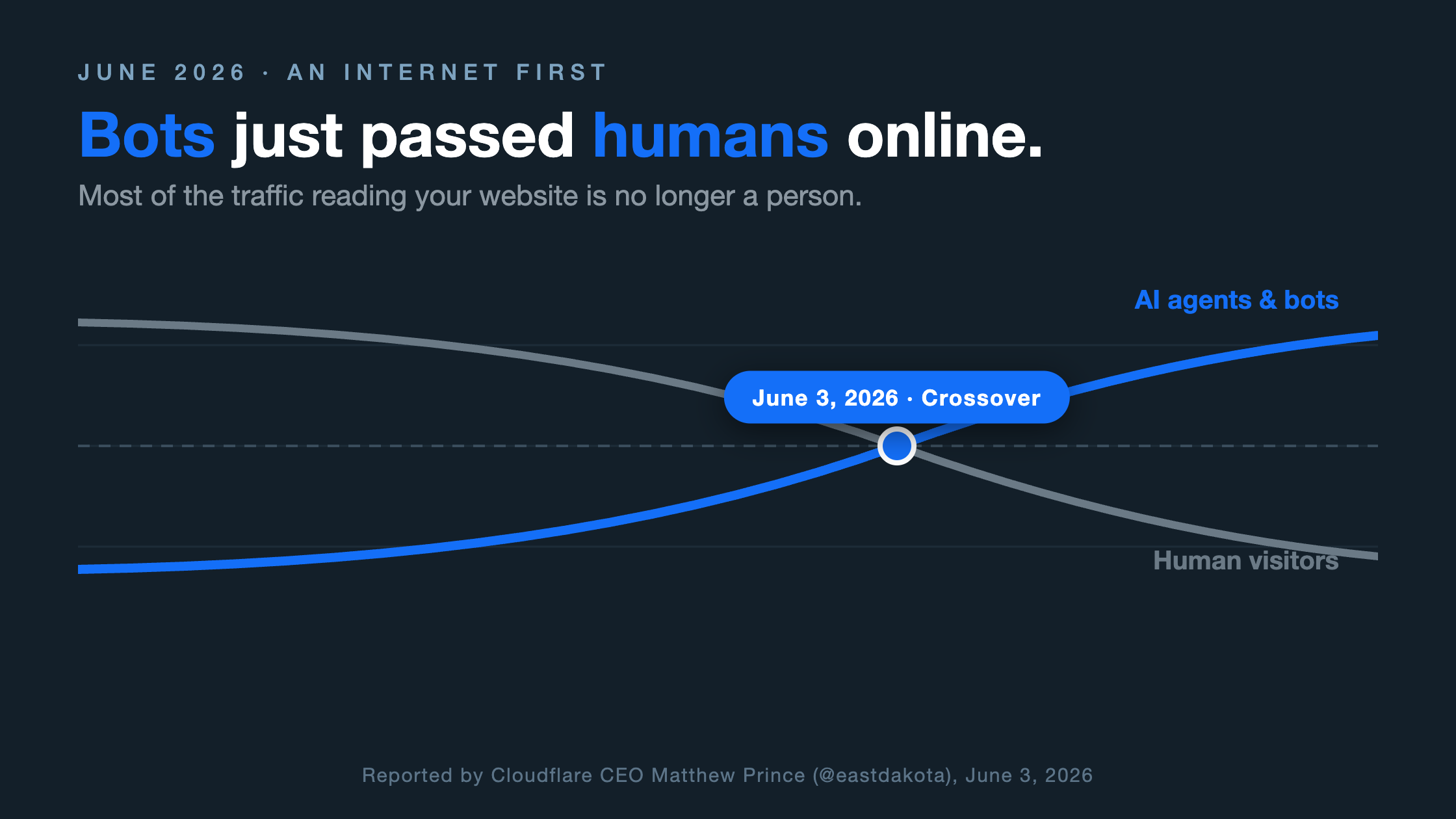
13 Jun Bots Just Passed Humans on the Internet. Here Is What We Did About It.
On June 3, the CEO of Cloudflare, the company that sits in front of roughly a fifth of the web and sees its traffic firsthand, posted something that should change how every business owner thinks about their website:
Welp, that happened faster than I predicted. Thought it would be end of 2027, then early 2027, but agentic traffic growing so fast that bots have now passed human traffic online for the first time in the Internet's history.
— Matthew Prince 🌥 (@eastdakota) June 3, 2026
For the first time in the history of the internet, the majority of traffic is not human. Prince expected this milestone in late 2027. It arrived a year and a half early, driven by the explosive growth of AI agents that read websites on behalf of the people who used to visit them.
This is not a curiosity for the tech press. It changes who your website is actually talking to, and it is the reason we spent a week auditing every client website we manage. Here is what the milestone means and what we did about it.
Your Website’s Biggest Audience Is Now Machines Acting for Humans
When a potential client asks ChatGPT for an estate planning attorney, asks Google’s AI Mode whether their child’s symptoms need a sick visit, or asks Perplexity for an HVAC company that services their neighborhood, a human never loads your homepage. An AI agent does. It reads your pages, weighs them against your competitors’ pages, and decides whether your business makes it into the answer.
That agent visit is now the norm, not the exception. The human shows up later, if at all, and often already holding a recommendation.
So the practical question for a business owner is no longer just “does my website convince a visitor?” It is “does my website give an AI agent something worth recommending?” Those turn out to be the same question, answered the same way, but most websites were never checked against it.
The Flood Goes Both Ways, and Google Drew a Line
Bots are not just reading the internet. They are writing it. The same tools driving agentic traffic let anyone publish ten thousand words of plausible content in an afternoon, and an enormous share of what gets posted now is machine-generated filler.
Google sees this more clearly than anyone, because it indexes all of it. That is why its new official guidance on generative AI features draws a hard line: content that “could originate from anyone,” meaning content a generic AI could produce without any access to your business, adds little and gets treated accordingly. Real experience, a real point of view, and content written for human readers are what its AI features reward. We broke down the full guidance in our analysis of Google’s AI search playbook.
Put the two facts together and the picture is stark. Machines now do most of the reading, machines do much of the writing, and the systems deciding who gets recommended are specifically tuned to find the content that machines could not have written. The scarce asset is not words. It is experience that required your business to exist.
What We Did for Our Clients the Week This Became Real
We do not treat milestones like this as commentary material. We treat them as a work order.
The same week Google’s guidance dropped, we connected to every client website we manage and audited each one, file by file. We removed leftover “AI optimization” artifacts like llms.txt files, which Google confirmed its systems ignore. We verified every site is clean against the published guidance. And we rebuilt our audit methodology around the new reality: our website audits now evaluate how a site reads to an AI agent, not just how it reads to a person, and they flag commodity content, meaning pages a generic AI could have written without knowing the business.
No client asked for this. No client got a bill for it. That is the difference between an agency that sells you tactics and one that watches the road for you.
Three Things to Check on Your Own Website This Month
- Ask who is actually reading it. If most of your traffic is now agents retrieving answers, your most important pages are the ones that answer real questions plainly: what you do, where you serve, what it costs, what makes you different. Buried answers do not get retrieved.
- Run the commodity test. Pick your five most important pages and ask: could a generic AI have written this without us? Every “yes” is a page that the systems deciding recommendations have no reason to prefer over a competitor’s version of the same filler.
- Audit for dead “AI optimization” weight. If a marketing company sold you llms.txt files, special AI markup, or chunked content, Google has now said in writing that none of it works, and some adjacent tactics carry spam policy exposure. Get it found and removed.
If you would rather have it done for you, that is the audit we now run as standard. Ask us for it before a competitor’s agency runs one on you. And if you want the deeper background on what Google’s guidance actually says, start with our plain-English guide to getting recommended by Google AI search.
The internet your website was built for had humans on the other end of every visit. That internet is gone, and it is not coming back. The businesses that adjust first are the ones the machines will be recommending while everyone else is still writing for an audience that stopped showing up.
Sources: Matthew Prince (@eastdakota), X, June 3, 2026; Google Search Central, “Optimizing your website for generative AI features on Google Search” (developers.google.com/search/docs/fundamentals/ai-optimization-guide).